Sunday, March 18, 2007

A asa ritmada / The Wings of Rhythm . . .


Motivo

Eu canto porque o instante existe
e a minha vida está completa.
Não sou alegre nem sou triste:
sou poeta.

Irmão das coisas fugidias,
não sinto gozo nem tormento.
Atravesso noites e dias
no vento.

Se desmorono ou se edifico,
se permaneço ou me desfaço,
- não sei, não sei. Não sei se fico
ou passo.

Sei que canto. E a canção é tudo.
Tem sangue eterno a asa ritmada.
E um dia sei que estarei mudo:
- mais nada.


Cecília Meireles


Motive

I sing for the moment
and my life is now complete.
I’m neither restless nor content:
I’m a poet.

Brother of ephemeral flights,
I don’t feel effort or ease.
I pass the days and nights
in a breeze.

To work or to play,
to hide or to show,
– I don’t know, I don’t know. I don’t know whether to stay
or to go.

I know that I sing. And the song is all one.
The wings of rhythm fly forevermore.
And one day I know I’ll be done:
– nothing more.


gringocarioca

Thursday, March 15, 2007

by the way

. . . here
I am still,
on the way,
a long way
along the way;
by the way,
on the way,
a long way
along the way,
there I am
still . . .


Copyright © 2007 Marco Alexandre de Oliveira

Monday, March 05, 2007

Post-Avant


I have nothing to say here.

There! I have said it all . . .


Copyright © 2007 Marco Alexandre de Oliveira

Monday, February 26, 2007

Poet . . .


Copyright © 2007 Marco Alexandre de Oliveira

$ign$ of the times . . .


Copyright © 2007 Marco Alexandre de Oliveira


Friday, February 23, 2007

write me!

Copyright © 2007 Marco Alexandre de Oliveira

Wednesday, February 21, 2007

El escritor revolucionario . . .

“Yo creo, y lo digo después de haber pesado largamente todos los elementos que entran en juego, que escribir para una revolución, que escribir dentro de una revolución, que escribir revolucionariamente, no significa, como creen muchos, escribir obligadamente acerca de la revolución misma. Por mi parte, creo que el escritor revolucionario es aquel en quien se fusionan indisolublemente la conciencia de su libre compromiso individual y colectivo, con esa otra so­berana libertad cultural que confiere el pleno dominio de su oficio. Si ese escritor, responsable y lúcido, decide escribir literatura fantástica, o psicológica, o vuelta hacia el pasado, su acto es un acto de libertad dentro de la revolución, y por eso es también un acto revolucionario aunque sus cuentos no se ocupen de las formas individuales o colectivas que adopta la revolución. Contrariamente al estrecho criterio de muchos que confunden literatura con pedagogía, literatura con enseñanza, literatura con adoctrinamiento ideológico, un escritor revolucionario tiene todo el derecho de dirigirse a un lector mucho más complejo, mucho más exigente en materia espiritual de lo que imaginan los escritores y los críticos improvisados por las circunstancias y convencidos de que su mundo personal es el único mundo existente, de que las preocupaciones del momento son las únicas preocupaciones válidas.”

(Julio Cortázar, “Algunos aspectos del cuento.”)

Sunday, February 18, 2007

Be the Pink Panther !?!

“The Pink Panther imitates nothing, it reproduces nothing, it paints the world its color, pink on pink; this is its becoming-world, carried out in such a way that it becomes imperceptible itself, asignifying, makes its rupture, its own line of flight, follows its ‘aparallel evolution’ through to the end.”

“Be the Pink Panther and your loves will be like the wasp and the orchid, the cat and the baboon.”


(Gilles Deleuze, A Thousand Plateaus. Trans. Brian Massumi)

Signs of Art . . .

“Learning is essentially concerned with signs. Signs are the objects of a temporal apprenticeship, not of an abstract knowledge. To learn is first of all to consider a substance, an object, a being as if it emitted signs to be deciphered, interpreted. . . . Vocation is always predestination with regard to signs. Everything that teaches us something emits signs; every act of learning is an interpretation of signs or hieroglyphs.”

“At the end of the Search, the interpreter understands what had escaped him . . . that the material meaning is nothing without an ideal essence that it incarnates. . . . Now the world of art is the ultimate world of signs, and these signs, as though dematerialized, find their meaning in an ideal essence. Henceforth, the world revealed by art reacts on all the others . . . it integrates them, colors them with an aesthetic meaning, and imbues what was still opaque about them. . . . This is why all the signs converge upon art; all apprenticeships, by the most diverse paths, are already unconscious apprenticeships to art itself. At the deepest level, the essential is in the signs of art.”


(Gilles Deleuze, Proust and Signs. Trans. Richard Howard)

Thursday, February 15, 2007

The Unknown I-land . . .

“quero encontrar a ilha desconhecida, quero saber quem sou eu quando nela estiver, Não o sabes, Se não sais de ti, não chegas a saber quem és . . . todo o homem é uma ilha . . . é necessário sair da ilha para ver a ilha, que não nos vemos se não nos saímos de nós, Se não saímos de nós próprios, queres tu dizer, Não é a mesma coisa.”

(José Saramago, O conto da ilha desconhecida)


“I want to find the unknown island, I want to find out who I am when I’m there on that island, Don’t you know, If you don’t step outside yourself, you’ll never discover who you are . . . each man is an island . . . you have to leave the island in order to see the island . . . we can’t see ourselves unless we become free of ourselves, Unless we escape from ourselves, you mean, No, that’s not the same thing.”

(José Saramago, The Tale of the Unknown Island. Trans. Margaret Jull Costa)

Tuesday, February 13, 2007

Pas de sens . . .

“What comes to pass in a sacred text is the occurrence of a pas de sens. And this event is also the one starting from which it is possible to think the poetic or literary text which tries to redeem the lost sacred and there translates itself as in its model. Pas de sens – that does not signify poverty of meaning but no meaning that would be itself, meaning, beyond any ‘literality.’ And right there is the sacred. The sacred surrenders itself to translation, which devotes itself to the sacred. The sacred would be nothing without translation, and translation would not take place without the sacred; the one and the other are inseparable.”

“the sacred text . . . is the absolute text because in its event it communicates nothing, it says nothing that would make sense beyond the event itself. . . . It is literally the literality of its tongue, ‘pure language’. . . . There is only letter, and it is the truth of pure language, the truth as pure language.”


(Jacques Derrida, Des Tours de Babel. Trans. Joseph F. Graham)

On Sense and Nonsense . . .

“The name saying its own sense can only be nonsense (Nn). Nonsense is of a piece with the word “nonsense,” and the word “nonsense” is of a piece with words which have no sense. . . .”

“One could object that all this means nothing. It is a bad play on words to suppose that nonsense expresses its own sense since, by definition, it has none. But this objection is unfounded. The play on words would be to say that nonsense has a sense, the sense being precisely that it hasn’t any. This is not our hypothesis at all.”

“Nonsense is that which has no sense, and that which, as such and as it enacts the donation of sense, is opposed to the absence of sense. This is what we must understand by “nonsense.”

“And how could we not feel that our freedom and strength reside, not in the divine universal nor in the human personality, but in these singularities which are more us than we ourselves are, more divine than the gods, as they animate concretely poem and aphorism, permanent revolution and partial action? What is bureaucratic in these fantastic machines which are peoples and poems? It suffices that we dissipate ourselves a little, that we be able to be at the surface, that we stretch our skin like a drum, in order that the ‘great politics’ begin. An empty square for neither man nor God; singularities which are neither general nor individual, neither personal nor universal. All of this is traversed by circulations, echoes, and events which produce more sense, more freedom, and more strength than man has ever dreamed of, or God ever conceived. Today’s task is to make the empty square circulate and to make pre-individual and nonpersonal singularities speak – in short, to produce sense.”


(Gilles Deleuze. The Logic of Sense. Trans. Mark Lester)

Sunday, February 11, 2007

On Words and Things . . .

“Must a name mean something?” Alice asked doubtfully.

“Of course it must,” Humpty Dumpty said with a short laugh: “my name means the shape I am – and a good handsome shape it is, too. With a name like yours, you might be any shape, almost.”

. . .

“When I use a word,” Humpty Dumpty said in a rather scornful tone, ‘’it means just what I choose it to mean – neither more or less.”

“The question is,” said Alice, “whether you can make words mean so many different things.”

“The question is,” said Humpty Dumpty, “which is to be master – that’s all.”


(Lewis Carroll, Through the Looking-Glass)

On Riddles without Answers . . .

“The Hatter opened his eyes very wide on hearing this; but all he said was, ‘Why is a raven like a writing-desk?’


‘Come, we shall have some fun now!’ thought Alice. ‘I’m glad they’ve begun asking riddles.– I believe I can guess that,’ she added aloud.


‘Do you mean that you think you can find out the answer to it?’ said the March Hare.


‘Exactly so,’ said Alice.


‘Then you should say what you mean,’ the March Hare went on.


‘I do,’ Alice hastily replied; ‘at least – at least I mean what I say – that’s the same thing, you know.’


‘Not the same thing a bit!’ said the Hatter. ‘You might just as well say that "I see what I eat" is the same thing as "I eat what I see"!’


‘You might just as well say,’ added the March Hare, ‘that "I like what I get" is the same thing as "I get what I like"!’


‘You might just as well say,’ added the Dormouse, who seemed to be talking in his sleep, ‘that "I breathe when I sleep" is the same thing as "I sleep when I breathe"!’


‘It is the same thing with you,’ said the Hatter, and here the conversation dropped, and the party sat silent for a minute, while Alice thought over all she could remember about ravens and writing-desks, which wasn’t much.”


. . .


‘Have you guessed the riddle yet?’ the Hatter said, turning to Alice again.


‘No, I give it up,’ Alice replied: ‘what’s the answer?’


‘I haven’t the slightest idea,’ said the Hatter.


‘Nor I,’ said the March Hare.


Alice sighed wearily. ‘I think you might do something better with the time,’ she said, ‘than waste it in asking riddles that have no answers.’”


(Lewis Carroll, Alice’s Adventures in Wonderland)

Saturday, February 10, 2007

A Revolutionary Dream . . .

“There are therefore two errors which in truth are one and the same: the error of reformism or technocracy, which aspires to promote or impose partial arrangements of social relations according to the rhythm of technical achievements; and the error of totalitarianism, which aspires to constitute a totalization of the signifiable and the known, according to the rhythm of the social totality existing at a given moment. The technocrat is the natural friend of the dictator – computers and dictatorship; but the revolutionary lives in the gap which separates technical progress from social totality, and inscribes there his dream of permanent revolution. This dream, therefore, is itself action, reality, and an effective menace to all established order; it renders possible what it dreams about.”

(Gilles Deleuze, The Logic of Sense. Trans. Mark Lester)

The (IL)LOGIC OF (NON)SENSE . . .

“But then, even if we suppose that the premises A and B are true, we can only conclude from this the proposition in question (let us call it Z) – we can only detach it from its premises and affirm it for itself independently of the implication – by admitting that Z is, in turn, true if A and B are true. This amounts to a proposition, C, which remains within the order of implication, and is unable to escape it, since it refers to a proposition, D, which states that ‘Z is true if A, B, and C are true. . . ,’ and so on to infinity.”

(Gilles Deleuze, The Logic of Sense. Trans. Mark Lester)

Thursday, February 08, 2007

La vida . . .

“Tal vez la vida consistía para los hombres en una serie de costumbres consentidas y continuas. Si alguna llegaba a quebrarse, probablemente se producía el desbarajuste, el fracaso. Y los hombres empezaban entonces a errar por las calles de la ciudad, a sentarse en los bancos de las plazas, cada día peor vestidos y con la barba más crecida. La vida . . . por lo tanto, consistía en llenar con una ocupación cada minuto del día.”

“Todo parecía detenerse, eterno y muy noble. Eso era la vida. Y había cierta grandeza en aceptarla así, mediocre, como algo definitivo, irremediable. Mientras del fondo de las cosas parecía brotar y subir una melodía de palabras graves y lentas que ella se quedó escuchando: ‘Siempre’. ‘Nunca’...Y así pasan las horas, los días y los años. ¡Siempre! ¡Nunca! ¡La vida, la vida!”

“Puede que la verdadera felicidad esté en la convicción de que se ha perdido irremediablemente la felicidad. Entonces empezamos a movernos por la vida sin esperanzas ni miedos, capaces de gozar por fin todos los pequeños goces, que son los más perdurables.”


(María Luisa Bombal, “El árbol”)

Wednesday, February 07, 2007

Borges y yo and I . . .

“Después reflexioné que todas las cosas le suceden a uno precisamente, precisamente ahora. Siglos de siglos y solo en el presente ocurren los hechos; inumerables hombres en el aire, en la tierra y el mar, y todo lo que realmente pasa me pasa a mí...”

(Jorge Luis Borges, “El jardín de senderos que se bifurcan.”)


“Then I reflected that all things happen to oneself, and happen precisely, precisely now. Century follows century, yet events occur only in the present; countless men in the air, on the land and sea, yet everything that truly happens, happens to me. . . .”

(Jorge Luis Borges, “The Garden of Forking Paths.” Trans. Andrew Hurley)

Tuesday, February 06, 2007

Where Truth Lies . . .

“One can say right off that the search for a way, for a truth, is not absent from our experience. For what else are we seeking in analysis if not a liberating truth?

But we must be careful. One must not always trust words and labels. This truth that we are seeking in a concrete experience is not that of a superior law. If the truth that we are seeking is a truth that frees, it is a truth that we will look for in a hiding place in our subject. It is a particular truth.”


“At the level of the unconscious, the subject lies. And this lying is his way of telling the truth of the matter.”


(Jacques Lacan, The Ethics of Psychoanalysis)

Monday, February 05, 2007

On Intention and Literary (Re)Creation . . .

“Art . . . posits man’s physical and spiritual existence, but in none of its works is it concerned with his response. No poem is intended for the reader, no picture for the beholder, no symphony for the listener.”

“The task of the translator consists in finding that intended effect [Intention] upon the language into which he is translating which produces in it the echo of the original. . . . translation does not find itself at the center of the language forest but on the outside facing the wooded ridge; it calls into it without entering, aiming at that single spot where the echo is able to give, in its own language, the reverberation of the work in the alien one.”

“to regain pure language fully formed in the linguistic flux, is the tremendous and only capacity of translation. In this pure language – which no longer means or expresses anything but is, as expressionless and creative Word, that which is meant in all languages – all information, all sense, and all intention finally encounter a stratum in which they are destined to be extinguished. This stratum furnishes a new and higher justification for free translation; this justification does not derive from the sense of what is to be conveyed, for the emancipation from this sense is the task of fidelity. . . . It is the task of the translator to release in his own language that pure language which is under the spell of another, to liberate the language imprisoned in a work in his re-creation of that work.”


(Walter Benjamin, “The Task of the Translator.” Trans. Harry Zohn)

Thursday, February 01, 2007

O mistério das coisas / The mystery of things

“O mistério das cousas, onde está ele?
Onde está ele que não aparece
Pelo menos a mostrar-nos que é mistério?
Que sabe o rio disso e que sabe a árvore?
E eu, que não sou mais do que eles, que sei disso?
Sempre que olho para as cousas e penso no que homens pensam delas,
Rio como um regato que soa fresco numa pedra,

Porque o único sentido oculto das cousas
É elas não terem sentido oculto nenhum,
É mais estranho do que todas as estranhezas
E do que os sonhos de todos os poetas
E os pensamentos de todos os filósofos,
Que as cousas sejam realmente o que parecem ser
E não haja nada que compreender.

Sim, eis o que os meus sentidos aprenderam sozinhos:
As cousas não têm significado: Têm existência.
As cousas são o único sentido oculto das cousas.”


(Alberto Caeiro / Fernando Pessoa)


“The mystery of things – where is it?
Why doesn’t it come out
To show us at least that it’s mystery?
What do the river and the tree know about it?
And what do I, who am no more than they, know about it?
Whenever I look at things and think about what people think of them,
I laugh like a brook cleanly splashing against a rock.

For the only hidden meaning of things
Is that they have no hidden meaning.
It’s the strangest thing of all,
Stranger than all poets’ dreams
And all philosophers’ thoughts,
That things are really what they seem to be
And there’s nothing to understand.

Yes, this is what my senses learned on their own:
Things have no meaning; they exist.
Things are the only hidden meaning of things.”


(Trans. Richard Zenith)

O Outro / The Other


"Eu não sou eu nem sou o outro,
Sou qualquer coisa de intermédio:
Pilar da ponte de tédio
Que vai de mim para o Outro."

– Mário de Sá-Carneiro


I am not myself or another,
I am something of a medium:
Pillar of the bridge of tedium
That spans from me to an Other.

– gringocarioca


Wednesday, January 31, 2007

Psycho(analy)tic Aphorisms . . .

“I think therefore I am.”

-René Descartes


“I must come to the place where that (id) was.”

-Sigmund Freud


“I think where I am not, therefore I am where I think not.”

-Jaques Lacan


“I is another.”

-Arthur Rimbaud


Saturday, January 27, 2007

The Spirit of the Letter . . .

“The letter killeth, but the spirit giveth life”

(2 Corinthians 3:6)


“Of course, as it is said, the letter killeth while the spirit giveth life. We can’t help but agree, having had to pay homage elsewhere to a noble victim of the error of seeking the spirit in the letter; but we should like to know, also, how the spirit could live without the letter. Even so, the claims of the spirit would remain unassailable if the letter had not in fact shown us that it can produce all the effects of truth in man without involving the spirit at all.”

(Jacques Lacan, “The Insistence of the Letter in the Unconscious”)

Friday, January 26, 2007

On Translation as Such . . .

“Where the most thorough possible interpretation occurs, where our sensibility appropriates its object while, in this appropriation, guarding, quickening that object’s autonomous life, the process is one of ‘original repetition.’ We re-enact, in the bounds of our own secondary but momentarily heightened, educated consciousness, the creation by the artist. We retrace, both in the image of a man drawing and of one following an uncertain path, the coming into form of the poem.”

“‘Interpretation’ as that which gives language life beyond the moment and place of immediate utterance or transcription, is what I am concerned with. . . . Through engagement of his own identity, a critic becomes un interpète – a life-giving performer . . . . Interprète / interpreter are commonly used to mean translator.”

“In short, the existence of art and literature, the reality of felt history in a community, depend on a never-ending, though very often unconscious, act of internal translation. It is no overstatement to say that we possess civilization because we have learnt to translate out of time.”

“Any model of communication is at the same time a model of trans-lation . . . . The element of privacy in language makes possible a crucial, though little understood, linguistic function. Its importance relates a study of translation to a theory of language as such. Obviously, we speak to communicate. But also to conceal, to leave unspoken. . . . In short: inside or between languages, human communication equals translation. A study of translation is a study of language.”

(George Steiner, After Babel)

After Babble . . .

“Do languages wane, do their powers of shaping response atrophy? Are there linguistic reflexes which have slowed and lost vital exactitude? The danger in putting the question this way is obvious: to think of the life and death of language in organic, temporal terms may be an animist fiction . . . . In certain civilizations there come epochs in which syntax stiffens, in which the available resources of live perception and restatement wither. Words seem to go dead under the weight of sanctified usage; the frequence and sclerotic force of clichés, of unexamined similes, of worn tropes increases. Instead of acting as a living membrane, grammar and vocabulary become a barrier to new feeling. A civilization is imprisoned in a linguistic contour which no longer matches, or matches only at certain ritual, arbitrary points, the changing landscape of facts.”

(George Steiner, After Babel)

Thursday, January 25, 2007

A Dream is a Dream is a Dream . . .

“Though this be true, I must nevertheless here consider that I am a man, and that, consequently, I am in the habit of sleeping, and representing to myself in dreams those same things, or even sometimes others less probable, which the insane think are presented to them in their waking moments. . . . I cannot forget that, at other times I have been deceived in sleep by similar illusions; and, attentively considering those cases, I perceive so clearly that there exist no certain marks by which the state of waking can ever be distinguished from sleep, that I feel greatly astonished; and in amazement I almost persuade myself that I am now dreaming.”

(René Descartes, Meditations. Trans. John Veitch)


“The interesting and allied problem, as to what is meant when some of the content of a dream is described in the dream itself as ‘dreamt’ – the enigma of the ‘dream within a dream’ – has been solved . . . . The intention is, once again, to detract from the importance of what is ‘dreamt’ in the dream, to rob it of its reality. What is dreamt in a dream after waking from the ‘dream within a dream’ is what the dream-wish seeks to put in the place of an obliterated reality. It is safe to suppose, therefore, that what has been ‘dreamt’ in the dream is a representation of the reality, the true recollection, while the continuation of the dream, on the contrary, merely represents what the dreamer wishes. To include something in a ‘dream within a dream’ is thus equivalent to wishing that the thing described as a dream had never happened.”

(Sigmund Freud, The Interpretation of Dreams. Trans. James Strachey)

Saturday, January 20, 2007

Meditations (A La Carte)


Copyright © 2004 Marco Alexandre de Oliveira

Meditation VI . . .

“And, in the first place, it cannot be doubted that in each of the dictates of nature there is some truth: for by nature, considered in general, I now understand nothing more than God himself, or the order and disposition established by God in created things; and by my nature in particular I understand the assemblage of all that God has given me.”

“I ought no longer to fear that falsity may be met with in what is daily presented to me by the senses. And I ought to reject all the doubts of those bygone days, as hyperbolical and ridiculous, especially the general uncertainty respecting sleep, which I could not distinguish from the waking state: for I now find a very marked difference between the two states, in respect that our memory can never connect our dreams with each other and with the course of life, in the way it is in the habit of doing with events that occur when we are awake. And, in truth, if some one, when I am awake, appeared to me all of a sudden and as suddenly disappeared, as do the images I see in sleep, so that I could not observe either whence he came or whither he went, I should not without reason esteem it either a specter or phantom formed in my brain, rather than a real man. But when I perceive objects with regard to which I can distinctly determine both the place whence they come, and that in which they are, and the time at which they appear to me, and when, without interruption, I can connect the perception I have of them with the whole of the other parts of my life, I am perfectly sure that what I thus perceive occurs while I am awake and not during sleep. And I ought not in the least degree to doubt of the truth of these presentations, if, after having called together all my senses, my memory, and my understanding for the purpose of examining them, no deliverance is given by any one of these faculties which is repugnant to that of any other: for since God is no deceiver, it necessarily follows that I am not herein deceived. But because the necessities of action frequently oblige us to come to a determination before we have had leisure for so careful an examination, it must be confessed that the life of man is frequently obnoxious to error with respect to individual objects; and we must, in conclusion, ac. knowledge the weakness of our nature.”


(René Descartes, Meditations. Trans. John Veitch)

http://www.wright.edu/cola/descartes/mede.html

Meditation V . . .

“Will it be said that perhaps I am dreaming (an objection I lately myself raised), or that all the thoughts of which I am now conscious have no more truth than the reveries of my dreams? But although, in truth, I should be dreaming, the rule still holds that all which is clearly presented to my intellect is indisputably true.”


(René Descartes, Meditations. Trans. John Veitch)

http://www.wright.edu/cola/descartes/mede.html

Meditation IV . . .

“It further occurs to me that we must not consider only one creature apart from the others, if we wish to determine the perfection of the works of Deity, but generally all his creatures together; for the same object that might perhaps, with some show of reason, be deemed highly imperfect if it were alone in the world, may for all that be the most perfect possible, considered as forming part of the whole universe . . . . I may occupy a place in the relation of a part to the great whole of his creatures.”


(René Descartes, Meditations. Trans. John Veitch)

http://www.wright.edu/cola/descartes/mede.html

Meditation III . . .

“I will now close my eyes, I will stop my ears, I will turn away my senses from their objects, I will even efface from my consciousness all the images of corporeal things; or at least, because this can hardly be accomplished, I will consider them as empty and false; and thus, holding converse only with myself, and closely examining my nature, I will endeavor to obtain by degrees a more intimate and familiar knowledge of myself. I am a thinking ( conscious ) thing, that is, a being who doubts, affirms, denies, knows a few objects, and is ignorant of many,-- [who loves, hates], wills, refuses, who imagines likewise, and perceives; for, as I before remarked, although the things which I perceive or imagine are perhaps nothing at all apart from me [and in themselves], I am nevertheless assured that those modes of consciousness which I call perceptions and imaginations, in as far only as they are modes of consciousness, exist in me.”

“But perhaps I am something more than I suppose myself to be, and it may be that all those perfections which I attribute to God, in some way exist potentially in me, although they do not yet show themselves, and are not reduced to act. Indeed, I am already conscious that my knowledge is being increased [and perfected] by degrees; and I see nothing to prevent it from thus gradually increasing to infinity, nor any reason why, after such increase and perfection, I should not be able thereby to acquire all the other perfections of the Divine nature; nor, in fine, why the power I possess of acquiring those perfections, if it really now exist in me, should not be sufficient to produce the ideas of them.”

“And I ask, from whom could I, in that case, derive my existence? Perhaps from myself, or from my parents, or from some other causes less perfect than God; for anything more perfect, or even equal to God, cannot be thought or imagined.

But if I [were independent of every other existence, and] were myself the author of my being, I should doubt of nothing, I should desire nothing, and, in fine, no perfection would be awanting to me; for I should have bestowed upon myself every perfection of which I possess the idea, and I should thus be God.”

“And, in truth, it is not to be wondered at that God, at my creation, implanted this idea in me, that it might serve, as it were, for the mark of the workman impressed on his work; and it is not also necessary that the mark should be something different from the work itself; but considering only that God is my creator, it is highly probable that he in some way fashioned me after his own image and likeness, and that I perceive this likeness, in which is contained the idea of God, by the same faculty by which I apprehend myself . . . . And the whole force of the argument of which I have here availed myself to establish the existence of God, consists in this, that I perceive I could not possibly be of such a nature as I am, and yet have in my mind the idea of a God, if God did not in reality exist--this same God, I say, whose idea is in my mind . . . .”


(René Descartes, Meditations. Trans. John Veitch)

http://www.wright.edu/cola/descartes/mede.html

Meditation II . . .

“I suppose, accordingly, that all the things which I see are false (fictitious); I believe that none of those objects which my fallacious memory represents ever existed; I suppose that I possess no senses; I believe that body, figure, extension, motion, and place are merely fictions of my mind. What is there, then, that can be esteemed true? Perhaps this only, that there is absolutely nothing certain.”

“But I had the persuasion that there was absolutely nothing in the world, that there was no sky and no earth, neither minds nor bodies; was I not, therefore, at the same time, persuaded that I did not exist? Far from it; I assuredly existed, since I was persuaded. But there is I know not what being, who is possessed at once of the highest power and the deepest cunning, who is constantly employing all his ingenuity in deceiving me. Doubtless, then, I exist, since I am deceived; and, let him deceive me as he may, he can never bring it about that I am nothing, so long as I shall be conscious that I am something. So that it must, in fine, be maintained, all things being maturely and carefully considered, that this proposition (pronunciatum) I am, I exist, is necessarily true each time it is expressed by me, or conceived in my mind.”

“Thinking is another attribute of the soul; and here I discover what properly belongs to myself. This alone is inseparable from me. I am--I exist: this is certain; but how often? As often as I think; for perhaps it would even happen, if I should wholly cease to think, that I should at the same time altogether cease to be. I now admit nothing that is not necessarily true. I am therefore, precisely speaking, only a thinking thing, that is, a mind (mens sive animus), understanding, or reason, terms whose signification was before unknown to me. I am, however, a real thing, and really existent; but what thing? The answer was, a thinking thing.”


(René Descartes, Meditations. Trans. John Veitch)

http://www.wright.edu/cola/descartes/mede.html

Meditation I . . .

“Several years have now elapsed since I first became aware that I had accepted, even from my youth, many false opinions for true, and that consequently what I afterward based on such principles was highly doubtful; and from that time I was convinced of the necessity of undertaking once in my life to rid myself of all the opinions I had adopted, and of commencing anew the work of building from the foundation . . . but, as the removal from below of the foundation necessarily involves the downfall of the whole edifice, I will at once approach the criticism of the principles on which all my former beliefs rested.”

“But this undertaking is arduous, and a certain indolence insensibly leads me back to my ordinary course of life; and just as the captive, who, perchance, was enjoying in his dreams an imaginary liberty, when he begins to suspect that it is but a vision, dreads awakening, and conspires with the agreeable illusions that the deception may be prolonged; so I, of my own accord, fall back into the train of my former beliefs, and fear to arouse myself from my slumber, lest the time of laborious wakefulness that would succeed this quiet rest, in place of bringing any light of day, should prove inadequate to dispel the darkness that will arise from the difficulties that have now been raised.”


(René Descartes, Meditations. Trans. John Veitch)

http://www.wright.edu/cola/descartes/mede.html

Thursday, January 18, 2007

¡Oh, la Poesía!

“¿Qué es eso? -preguntó.

-Señor, es un poeta.

El rey tenía cisnes en el estanque, canarios, gorriones, censotes en la pajarera: un poeta era algo nuevo y extraño.

-Dejadle aquí.

Y el poeta:

-Señor, no he comido.

Y el rey:

-Habla y comerás.

Comenzó:

-Señor, ha tiempo que yo canto el verbo del porvenir. He tendido mis alas al huracán; he nacido en el tiempo de la aurora; busco la raza escogida que debe esperar con el himno en la boca y la lira en la mano, la salida del gran sol. He abandonado la inspiración de la ciudad malsana, la alcoba llena de perfumes, la musa de carne que llena el alma de pequeñez y el rostro de polvos de arroz. He roto el arpa adulona de las cuerdas débiles, contra las copas de Bohemia y las jarras donde espumea el vino que embriaga sin dar fortaleza; he arrojado el manto que me hacía parecer histrión, o mujer, y he vestido de modo salvaje y espléndido: mi harapo es de púrpura. He ido a la selva, donde he quedado vigoroso y ahíto de leche fecunda y licor de nueva vida; y en la ribera del mar áspero, sacudiendo la cabeza bajo la fuerte y negra tempestad, como un ángel soberbio, o como un semidiós olímpico, he ensayado el yambo dando al olvido el madrigal.

He acariciado a la gran naturaleza, y he buscado al calor del ideal, el verso que está en el astro en el fondo del cielo, y el que está en la perla en lo profundo del océano. ¡He querido ser pujante! Porque viene el tiempo de las grandes revoluciones, con un Mesías todo luz, todo agitación y potencia, y es preciso recibir su espíritu con el poema que sea arco triunfal, de estrofas de acero, de estrofas de oro, de estrofas de amor.

¡Señor, el arte no está en los fríos envoltorios de mármol, ni en los cuadros lamidos, ni en el excelente señor Ohnet! ¡Señor! El arte no viste pantalones, ni habla en burgués, ni pone los puntos en todas las íes. Él es augusto, tiene mantos de oro o de llamas, o anda desnudo, y amasa la greda con fiebre, y pinta con luz, y es opulento, y da golpes de ala como las águilas, o zarpazos como los leones. Señor, entre un Apolo y un ganso, preferid el Apolo, aunque el uno sea de tierra cocida y el otro de marfil.

¡Oh, la Poesía!”


(Ruben Darío, “El Rey Burgués”)


Monday, January 15, 2007

"The Child is Father of the Man"


Celso Daniel Garcia de Oliveira


“My heart leaps up when I behold
A rainbow in the sky:
So was it when my life began;
So is it now I am a man;
So be it when I shall grow old,
Or let me die!
The Child is father of the Man;
I could wish my days to be
Bound each to each by natural piety.”

(William Wordsworth)

Monday, January 01, 2007

Auld Lang Syne

"Should auld [1] acquaintance be forgot,
and never brought to mind ?
Should auld acquaintance be forgot,
and auld lang syne ?

CHORUS:

For auld lang syne, my dear,
for auld lang syne,
we’ll tak a cup o’ kindness yet,
for auld lang syne.

And surely ye’ll be [2] your pint-stowp [3]!
And surely I’ll be mine !
And we’ll tak a cup o’ kindness yet,
for auld lang syne.

CHORUS

We twa [4] hae [5] run about the braes [6],
and pou’d [7] the gowans [8] fine ;
But we’ve wander’d mony [9] a weary fit [10],
sin’ [11] auld lang syne.

CHORUS

We twa hae paidl’d [12] in the burn [13],
frae [14] morning sun till dine [15] ;
But seas between us braid [16] hae roar’d
sin’ auld lang syne.

CHORUS

And there’s a hand, my trusty fiere [17] !
And gies [18] a hand o’ thine !
And we’ll tak a right gude-willie-waught [19],
for auld lang syne.

CHORUS"


(Robert Burns, Songs from Robert Burns)


[1] old

[2] buy

[3] cup

[4] two

[5] have

[6] hills

[7] pulled

[8] daisies

[9] many

[10] foot

[11] since

[12] paddled

[13] stream

[14] from

[15] dinner

[16] broad

[17] friend

[18] give

[19] good-will-draught

Wednesday, December 27, 2006

SOS . . .


Copyright © 2006 Marco Alexandre de Oliveira

imaginatext . . .


Copyright © 2006 Marco Alexandre de Oliveira

Monday, December 25, 2006

NATALE . . .

“The people who walked in darkness have seen a great light; upon those who dwelt in the land of gloom a light has shone.

You have brought them abundant joy and great rejoicing, as they rejoice before you as at the harvest, as men make merry when dividing spoils.

For the yoke that burdened them, the pole on their shoulder, and the rod of their taskmaster you have smashed, as on the day of Midian.

For every boot that tramped in battle, every cloak rolled in blood, will be burned as fuel for flames.

For a child is born to us, a son is given us; upon his shoulder dominion rests. They name him Wonder-Counselor, God-Hero, Father-Forever, Prince of Peace.”

(Isaiah 9:2 – 9:6)


“In the beginning was the Word,
and the Word was with God,
and the Word was God.
He was in the beginning with God.
All things came to be through him,
and without him nothing came to be.
What came to be through him was life,
and this life was the light of the human race;
the light shines in the darkness,
and the darkness has not overcome it.”

(John 1:1 – 1:5)

Saturday, December 09, 2006

A Simple Question . . .

“What is the meaning of life? That was all – a simple question; one that tended to close in on one with years. The great revelation had never come. The great revelation perhaps never did come. Instead there were little daily miracles, illuminations, matches struck unexpectedly in the dark . . .”

(Virginia Woolf, To the Lighthouse)

Tuesday, December 05, 2006

moon(s) . . .


Copyright © 2006 Marco Alexandre de Oliveira

Tuesday, November 28, 2006

(w)rite . . .


Copyright © 2006 Marco Alexandre de Oliveira

Sunday, November 26, 2006

poetree

bears a tree with bare branches stems from parched bark and twisted twigs leaves fallen leaves to winter wind roots the sky in dry earth sprouts within and blooms without flowers the seeds of trees . . .


Copyright © 2006 Marco Alexandre de Oliveira

On the Edge of Happiness . . .

“It was his fate, his peculiarity, whether he wished it or not, to come out thus on a spit of land which the sea is slowly eating away, and there to stand, like a desolate sea-bird, alone. It was his power, his gift, suddenly to shed all superfluities, to shrink and diminish so that he looked barer and felt sparer, even physically, yet lost none of his intensity of mind, and so to stand on his little ledge facing the dark of human ignorance, how we know nothing and the sea eats away the ground we stand on – that was his fate, his gift.”

“He turned from the sight of human ignorance and human fate and the sea eating the ground we stand on, which, had he been able to contemplate it fixedly might have led to something; and found consolation in trifles so slight compared with the august theme just now before him that he was disposed to slur the comfort over, to deprecate it, as if to be caught happy in a world of misery was for an honest man the most despicable of crimes. It was true; he was for the most part happy. . . .”


(Virginia Woolf, To the Lighthouse)

Wednesday, November 22, 2006

Medium . . .


Copyright © 2006 Marco Alexandre de Oliveira

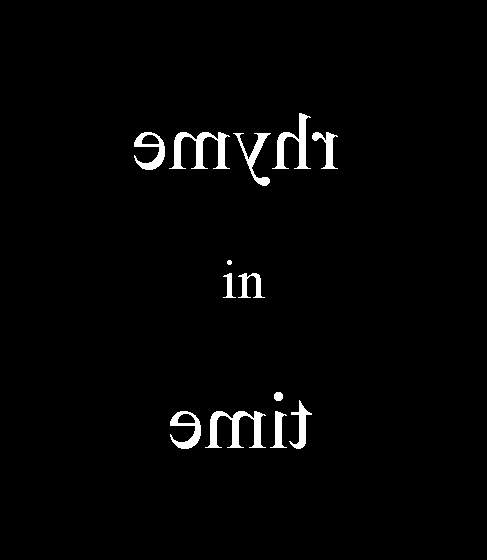
A Time to Rhyme


only herds
of lonely words –
a faceless multitude,
a baseless solitude –
traverse in verse
the pages of the ages.

names in frames – like you and I – as real and ideal as earth and sky, wander around and wonder about the signs they signify, or the nature of their stature, from their birth until they die; for still the years still transform begotten forms until appearances disappear along with long forgotten formal norms of characterization, characterized by characters in action . . . of course, perhaps this so-called individual discourse, per se, after all never original, is always and ever a source of hype, a perverse type of blend adverse to trends and style; while meanwhile seen as a genius of a genus, is such, as such, in a sense, in essence, a nonsense, since this revolution of resolution is the expression of impressions of the same rules from whence it came; hence fools become tools of a tragic logic as subjects object to a language of bondage: “objects subject to the bondage of language!” the former insists, the latter resists – letters in fetters digress, impede progress – the stampede tramples over borders of thought, these orders that ought to contain and restrain remain what sustain a predestined ambition: to end and transcend a questioned condition, a unique and oblique obsession reflective of a perspective of oppression . . . finally a finale – herds of words are heard! a leader elects to select a reader to free the story from history, and (re)present the advent of the moment, to see all class as allegory, and pass the time(s) with rhyme(s). . . .


Copyright © 2006 Marco Alexandre de Oliveira

On Sesame and Lilies . . .

“And be sure also, if the writer is worth anything, that you will not get at his meaning all at once; – nay, that at his whole meaning you will not for a long time arrive in any wise. Not that he does not say what he means, and in strong words too; but he cannot say it all; and what is more strange, will not, but in a hidden way and in parables, in order that he may be sure you want it. I cannot quite see the reason of this, nor analyze that cruel reticence in the breasts of wise men which makes them always hide their deeper thought. They do not give it you by way of help, but of reward; and will make themselves sure that you deserve it before they allow you to reach it. . . ."


(John Ruskin, Sesame and Lilies)

Saturday, November 18, 2006

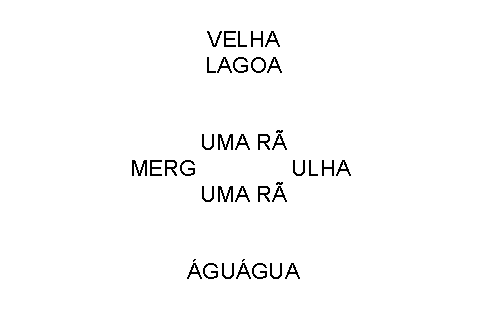
Velha lagoa / Old pond . . .


(Décio Pignatari – cited in Matsuo Bashô: A lágrima do peixe, by Paulo Leminski)


Copyright © 2006 Marco Alexandre de Oliveira

O velho tanque / The old pond . . .


(Haroldo de Campos , A arte no horizonte do provável, 1969)


Copyright © 2006 Marco Alexandre de Oliveira

Thursday, November 16, 2006

Impressions on Art . . .

“And what other means were open to me than the creation of a work of art?”

“Thus I had already reached the conclusion that we are in no wise free in the presence of a work of art, that we do not create it as we please but that it pre-exists in us and we are compelled as though it were a law of nature to discover it because it is at once hidden from us and necessary. But is not that discovery, which art may enable us to make, most precious to us, a discovery of that which for most of us remains for ever unknown, our true life, reality as we have ourselves felt it and which differs so much from that which we had believed that we are filled with delight when chance brings us an authentic revelation of it?”

“The grandeur of veritable art . . . is to recapture, to lay hold of, to make one with ourselves that reality far removed from the one we live in, from which we separate ourselves more and more as the knowledge which we substitute for it acquires a greater solidity and impermeability, a reality we run the risk of never knowing before we die but which is our real, our true life at last revealed and illumined, the only life which is really lived and which in one sense lives at every moment in all men as well as in the artist. But they do not see it because they do not seek to illuminate it. And thus their past is encumbered with innumerable “negatives” which remain useless because the intelligence has not “developed” them. To lay hold of our life; and also the life of others; for a writer’s style and also a painter’s are matters not of technique but of vision. It is the revelation, impossible by direct and conscious means, of the qualitative difference there is in the way in which we look at the world, a difference which, without art, would remain for ever each man’s personal secret. By art alone we are able to get outside ourselves, to know what another sees of this universe which for him is not ours, the landscapes of which would remain as unknown to us as those of the moon. Thanks to art, instead of seeing one world, our own, we see it multiplied and as many original artists as there are, so many worlds are at our disposal, differing more widely from each other than those which roll round the infinite and which . . . send us their unique rays many centuries after the hearth from which they emanate is extinguished. This labour of the artist to discover a means of apprehending beneath matter and experience, beneath words, something different from their appearance . . . this complex art is precisely the only living art. It alone expresses for others and makes us see, our own life, that life which cannot observe itself, the outer forms of which, when observed, need to be interpreted and often read upside down, in order to be laboriously deciphered.”


Marcel Proust, Time Regained (Vol. 7 of Remembrance of Things Past. Trans. Stephen Hudson)

A Book of Symbols . . .

“I was attempting to concentrate my mind on a compelling image, a cloud, a triangle, a belfry, a flower, a pebble, believing that there was perhaps something else under those symbols I ought to try to discover, a thought which these objects were expressing in the manner of hieroglyphic characters which one might imagine only represented material objects. Doubtless such deciphering was difficult, but it alone could yield some part of the truth.”

“That book of unknown signs within me (signs in relief it seemed, for my concentrated attention, as it explored my unconscious in its search, struck against them, circled round them like a diver sounding) no one could help me read by any rule, for its reading consists in an act of creation in which no one can take our place and in which no one can collaborate . . . That book which is the most arduous of all to decipher is the only one which reality has dictated, the only one printed within us by reality itself. Whatever idea life has left in us, its material shape, mark of the impression it has made on us, is still the necessary pledge of its truth . . . Our only book is that one not made by ourselves whose characters are already imaged . . . That which we have not been forced to decipher, to clarify by our own personal effort, that which was made clear before, is not ours. Only that issues from ourselves which we ourselves extract from the darkness within ourselves and which is unknown to others. And as art exactly recomposes life, an atmosphere of poetry surrounds those truths within ourselves to which we attain, the sweetness of a mystery which is but the twilight through which we have passed.”

“I perceived that to express those impressions, to write that essential book, which as the only true one, a great writer does not, in the current meaning of the word, invent it, but, since it exists already in each one of us, interprets it. The duty and the task of a writer are those of an interpreter.”


Marcel Proust, Time Regained (Vol. 7 of Remembrance of Things Past. Trans. Stephen Hudson)

Tuesday, November 14, 2006

Doors to Nowhere . . .

“But it is sometimes just at the moment when we think that everything is lost that the intimation arrives which may save us; one has knocked at all the doors which lead nowhere, and then one stumbles without knowing it on the only door through which one can enter – which one might have sought in vain for a hundred years – and it opens of its own accord.”

Marcel Proust, Time Regained. (Vol. 7 of Remembrance of Things Past. Trans. Moncrieff and Kilmartin)

Monday, November 13, 2006

In Search of Lost Hope . . .

"How often . . . did I reflect on my lack of qualification for a literary career, and that I must abandon all hope of ever becoming a famous author. The regret that I felt for this, while I lingered alone to dream for a little by myself, made me suffer so acutely that, in order not to feel it, my mind of its own accord, by a sort of inhibition in the instant of pain, ceased entirely to think of verse-making, of fiction, of the poetic future on which my want of talent precluded me from counting. Then, quite apart from all those literary preoccupations, and without definite attachment to anything, suddenly a roof, a gleam of sunlight reflected from a stone, the smell of a road would make me stop still, to enjoy the special pleasure that each of them gave me, and also because they appeared to be concealing, beneath what my eyes could see, something which they invited me to approach and seize from them, but which, despite all my efforts, I never managed to discover. As I felt that the mysterious object was to be found in them, I would stand there in front of them, motionless, gazing, breathing, endeavouring to penetrate with my mind beyond the thing seen or smelt. And if I had then . . . to proceed on my way, I would still seek to recover my sense of them by closing my eyes; I would concentrate upon recalling exactly the line of the roof, the colour of the stone, which, without my being able to understand why, had seemed to me to be teeming, ready to open, to yield up to me the secret treasure of which they were themselves no more than the outer coverings. It was certainly not any impression of this kind that could or would restore the hope I had lost of succeeding one day in becoming an author and poet, for each of them was associated with some material object devoid of any intellectual value, and suggesting no abstract truth. But at least they gave me an unreasoning pleasure, the illusion of a sort of fecundity of mind; and in that way distracted me from the tedium, from the sense of my own impotence which I had felt whenever I had sought a philosophic theme for some great literary work . . . ."


[Swann's Way (Vol. 1 of Remembrance of Things Past) by Marcel Proust, translated from the French by C. K. Scott Moncrieff (1922)]

http://www.authorama.com/remembrance-of-things-past-4.html

Thursday, November 09, 2006

A ti, Tati . . .


Copyright © 2006 Marco Alexandre de Oliveira

Tuesday, November 07, 2006

ut pictura poesis

diga ao poeta que veja o pintor
ver no poema o que dizer na pintura
da figura a compor:

o inverso do universo em verso


Copyright © 2006 Marco Alexandre de Oliveira

Sunday, November 05, 2006

On Reading (Proust) . . .

“And then my thoughts, did not they form a similar sort of hiding-hole, in the depths of which I felt that I could bury myself and remain invisible even when I was looking at what went on outside? When I saw any external object, my consciousness that I was seeing it would remain between me and it, enclosing it in a slender, incorporeal outline which prevented me from ever coming directly in contact with the material form; for it would volatilise itself in some way before I could touch it . . . Upon the sort of screen, patterned with different states and impressions, which my consciousness would quietly unfold while I was reading, and which ranged from the most deeply hidden aspirations of my heart to the wholly external view of the horizon spread out before my eyes at the foot of the garden, what was from the first the most permanent and the most intimate part of me, the lever whose incessant movements controlled all the rest, was my belief in the philosophic richness and beauty of the book I was reading, and my desire to appropriate these to myself, whatever the book might be. For even if I had purchased it . . . I should have noticed and bought it there simply because I had recognised it as a book which had been well spoken of, in my hearing, by the school-master or the school-friend who, at that particular time, seemed to me to be entrusted with the secret of Truth and Beauty, things half-felt by me, half-incomprehensible, the full understanding of which was the vague but permanent object of my thoughts.”

“Next to this central belief, which, while I was reading, would be constantly a motion from my inner self to the outer world, towards the discovery of Truth, came the emotions aroused in me by the action in which I would be taking part, for these afternoons were crammed with more dramatic and sensational events than occur, often, in a whole lifetime. These were the events which took place in the book I was reading . . .But none of the feelings which the joys or misfortunes of a ‘real’ person awaken in us can be awakened except through a mental picture of those joys or misfortunes; and the ingenuity of the first novelist lay in his understanding that, as the picture was the one essential element in the complicated structure of our emotions, so that simplification of it which consisted in the suppression, pure and simple, of ‘real’ people would be a decided improvement. A ‘real’ person, profoundly as we may sympathise with him, is in a great measure perceptible only through our senses, that is to say, he remains opaque, offers a dead weight which our sensibilities have not the strength to lift . . .The novelist’s happy discovery was to think of substituting for those opaque sections, impenetrable by the human spirit, their equivalent in immaterial sections, things, that is, which the spirit can assimilate to itself. After which it matters not that the actions, the feelings of this new order of creatures appear to us in the guise of truth, since we have made them our own, since it is in ourselves that they are happening, that they are holding in thrall, while we turn over, feverishly, the pages of the book, our quickened breath and staring eyes. And once the novelist has brought us to that state, in which, as in all purely mental states, every emotion is multiplied ten-fold, into which his book comes to disturb us as might a dream, but a dream more lucid, and of a more lasting impression than those which come to us in sleep; why, then, for the space of an hour he sets free within us all the joys and sorrows in the world, a few of which, only, we should have to spend years of our actual life in getting to know, and the keenest, the most intense of which would never have been revealed to us because the slow course of their development stops our perception of them. It is the same in life; the heart changes, and that is our worst misfortune; but we learn of it only from reading or by imagination; for in reality its alteration, like that of certain natural phenomena, is so gradual that, even if we are able to distinguish, successively, each of its different states, we are still spared the actual sensation of change.”

“Had my parents allowed me, when I read a book, to pay a visit to the country it described, I should have felt that I was making an enormous advance towards the ultimate conquest of truth. For even if we have the sensation of being always enveloped in, surrounded by our own soul, still it does not seem a fixed and immovable prison; rather do we seem to be borne away with it, and perpetually struggling to pass beyond it, to break out into the world, with a perpetual discouragement as we hear endlessly, all around us, that unvarying sound which is no echo from without, but the resonance of a vibration from within. We try to discover in things, endeared to us on that account, the spiritual glamour which we ourselves have cast upon them; we are disillusioned, and learn that they are in themselves barren and devoid of the charm which they owed, in our minds, to the association of certain ideas; sometimes we mobilise all our spiritual forces in a glittering array so as to influence and subjugate other human beings who, as we very well know, are situated outside ourselves, where we can never reach them . . . .”


[Swann's Way (Vol. 1 of Remembrance of Things Past) by Marcel Proust, translated from the French by C. K. Scott Moncrieff (1922)]

http://www.authorama.com/remembrance-of-things-past-4.html